
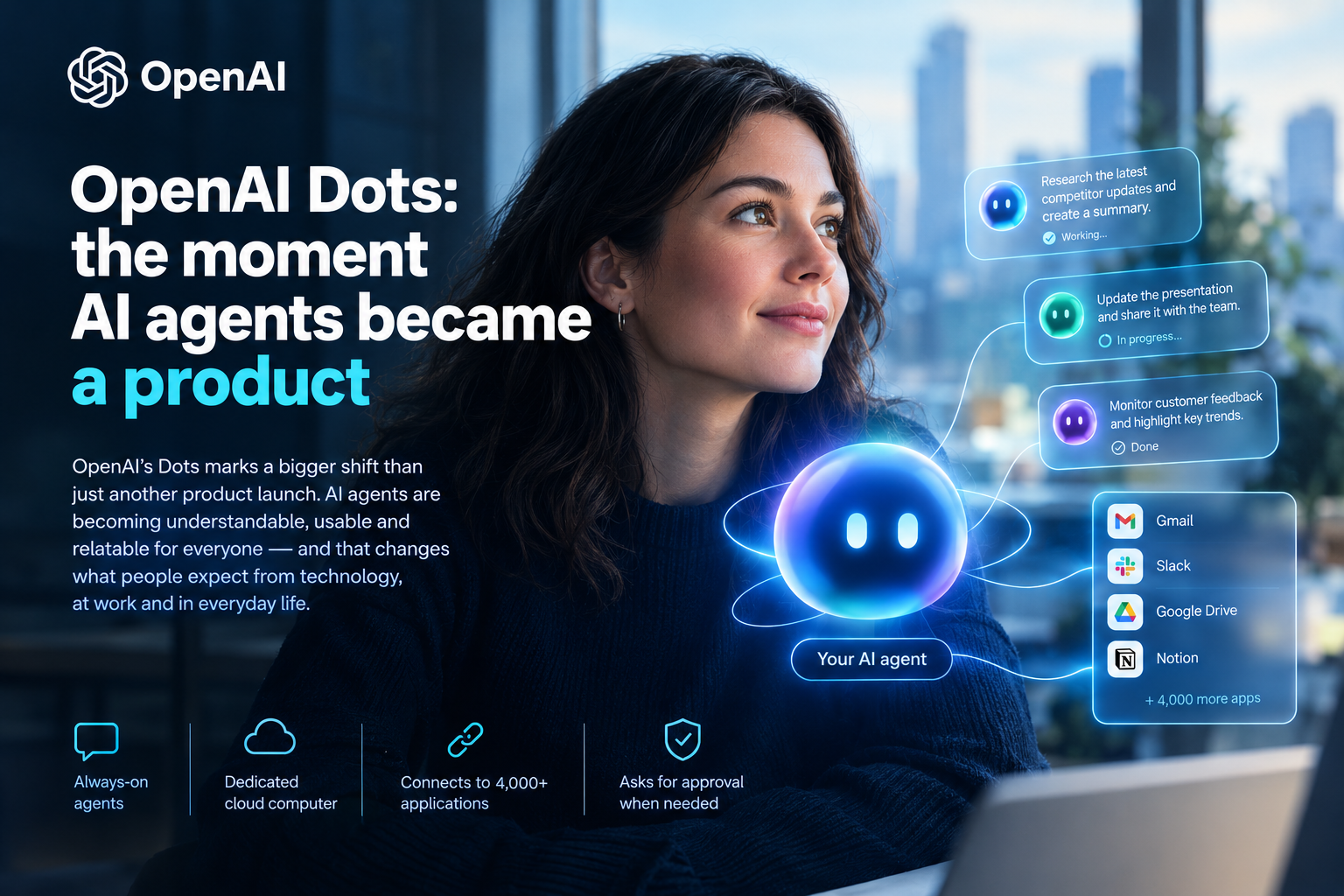
Something shifted this week — and it wasn't the technology. It was the way we finally got to talk about it.
For years the AI industry has been asking the market to learn its vocabulary. Reasoning. Tool calling. Orchestration. Autonomous loops. Context windows. Agent architecture. The words were precise, but they described machinery rather than meaning. The promised revolution was explained constantly and experienced rarely.
OpenAI's introduction of Dots is the moment that changed. Dots are always-on AI agents designed to work toward a user's goals, operate across applications, continue working in the background, and ask for approval when an important action requires human judgement. They run on dedicated cloud computers and connect to more than 4,000 applications. They can be reached through ChatGPT and through workplace environments such as Slack and Teams.
That is the specification. The meaning is simpler, and much larger: the AI agent has become a product ordinary people can understand — not because they studied how it works, but because they can finally give it work to do.
A product, not a technology
For the last several years the industry was busy explaining what agents are. Now the leading AI companies are beginning to show people why they should want one. That changes the marketing problem. The market no longer needs lectures on tool calls or memory. It needs a sentence it can understand.
The sentence is the same across every serious launch this autumn: give me the work. It is short, it is human, and it establishes a new expectation — software should not only help you do the work. It should be able to do part of the work for you.
From asking AI to giving AI work
There is a quiet progression in how we relate to intelligent software, and it is worth naming plainly.
First came ask AI a question. Chatbots, search-like experiences, an answer arriving — and then the interaction ending. The user was still responsible for turning the answer into action.
Then came work with AI. Copywriting, code generation, spreadsheet analysis. The AI became a collaborator inside a specific task — but the human still initiated every step.
And now comes give AI a goal. The user describes an outcome. The agent builds a plan, acts across applications, monitors the situation, and continues working after the user has left. The human is no longer the initiator of every step. The human is the one who defines intent and approves what matters.
Three stages of working with AI — from asking to delegating.
Meta's Muse confirms the pattern
Dots did not appear in isolation. On September 8, Meta introduced Muse — described as a personal AI agent “built for everyone.” The positioning is deliberately plain: the user gives Muse a goal, Muse develops a plan, takes actions across applications, and continues working after the app is closed.
The two products are different. Their technologies, ecosystems and business models diverge. But in the same month, they teach the market the same idea: AI does not have to wait for you.
That sentence will be understood by hundreds of millions of people who will never read a paper about tool calling.
The employee is about to bring agents to work
This is where the story stops being about consumer software and starts being about the enterprise.
Imagine someone who has spent the last six months delegating to an agent in their personal life. Research. Drafts. Planning. Monitoring. Coordination across their own tools. The agent is always on. It asks for approval when something matters. It keeps working while they are elsewhere.
Then that person arrives at the office.
At work, the same person is expected to copy information between four systems. To reconcile two CRMs that disagree about what a customer is. To search a shared drive for a document last updated in 2023. To wait three days for a routine approval that exists only because a policy from 2018 demanded it.
The contrast will not be lost on them.
Microsoft's 2026 Work Trend Index — based on 20,000 AI users across ten markets — found a meaningful gap between individual readiness to work with AI and organisational readiness to support it. Ten percent of respondents fell into a group Microsoft calls “Blocked Agency”: high individual AI capability, low organisational readiness. Another nineteen percent were in the “Frontier” group, where the two reinforce each other.
Microsoft also reports that active agents in its Microsoft 365 ecosystem grew fifteen-fold year over year — with even faster growth inside large enterprises.
The direction is unmistakable. People are learning to work with agents faster than many organisations are redesigning themselves around that fact.
An agent can access an enterprise without understanding it
Here is the trap, and it is worth stating plainly.
An agent can connect to thousands of applications. It can read the CRM. It can query the ERP. It can search Slack. It can open documents. It can call APIs. It can move data between systems.
None of that, on its own, is the enterprise.
The enterprise is the structure that connects those systems. It is the set of shared meanings beneath them: what counts as a customer, what makes a customer approved, which contract governs a given relationship, which process applies, who has authority to approve what, which KPI is authoritative, which system is the source of truth, what happens when two policies disagree, and what the word completed actually means.
These are not questions another API connection can answer. They are questions about the enterprise itself.
Where the agent era meets Enterprise Design
The arrival of capable agents does not make enterprise architecture less important. It makes the underlying enterprise model more important — because agents move faster than humans, and speed amplifies both coherence and chaos.
The question changes from how do we connect AI to our systems? to what does AI need to understand about our enterprise in order to operate inside it?
That leads to a different architecture:
Enterprise Reality → Enterprise Understanding → Enterprise Ontology → Enterprise Blueprint → Enterprise Operating Platform → Enterprise AI → Runtime Evidence → Continuous Evolution.
The agent is one layer inside this system. It is not the system itself.
The agent becomes the interface
Consider two working days.
Today, a manager who needs something done opens the CRM, finds the customer, opens the contract, checks the status, creates a task, updates the project, and notifies finance. Seven steps across five systems. Each one a small act of translation between systems that do not know about each other.
Tomorrow, the same manager says: the customer changed the contract terms — check what this affects, update the relevant work, prepare the required approvals, and tell me what needs my decision.
For that sentence to work, the agent does not need to be smarter. It needs to be contextualised. It needs to know what the customer is. Which contract is authoritative. Which projects depend on it. Who owns the decision. Which policies apply. Which systems must be updated. Which actions require approval. And how the whole operation should be recorded — for the next person, the next agent, and the next audit.
That is not an AI problem. It is an enterprise design problem.
The bottom line
The first wave of enterprise AI was about adoption. Where can we use AI?
The second wave is about delegation. What work can we give to agents?
The third wave — the one Dots and Muse are quietly announcing — is about architecture. What kind of enterprise allows agents to work together safely, coherently and at scale?
The question is no longer whether enterprises will use agents. It is whether the enterprise itself is designed for them.
The agent becomes the interface. The enterprise model becomes the foundation. And the companies that understand this before the market forces them to will be the ones whose agents actually work.