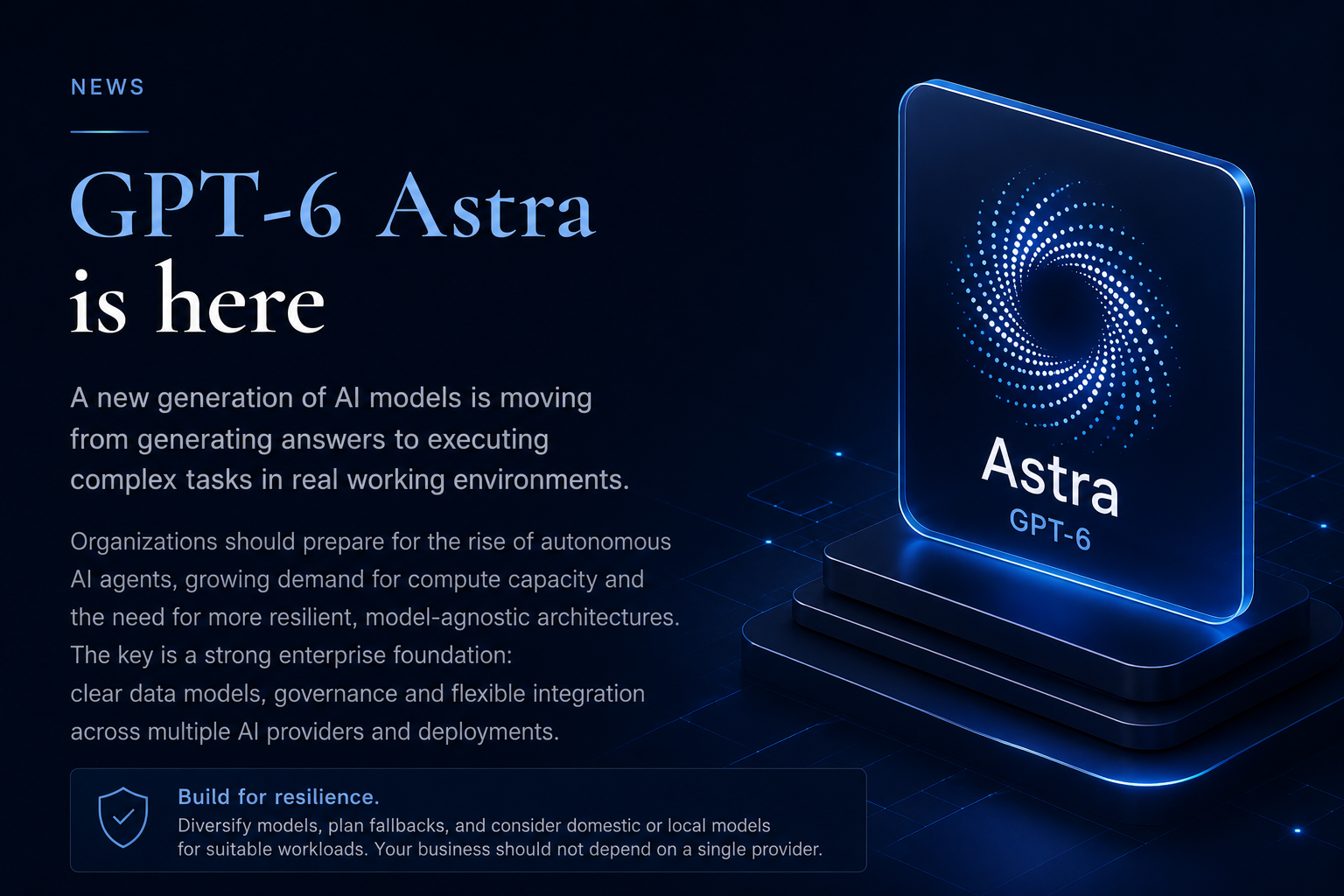
In September 2026, OpenAI unveiled GPT‑6 Astra — a model that doesn’t just write better code. Astra can operate software environments, execute workflows, test results, navigate applications, and continue complex multi‑step work.
Almost simultaneously, Anthropic released Claude Fable 5.1, confirming that long‑running agentic tasks are becoming a broader industry direction rather than the advantage of a single provider.
This changes the question enterprises should be asking.
It is no longer simply:
“How can we use AI to write software faster?”
It is becoming:
“How should an enterprise be structured so that increasingly autonomous AI systems can safely understand, build, and evolve its software?”
From AI‑Assisted to AI‑Operated Development
Earlier generations of AI‑assisted development primarily improved the productivity of individual engineers.
- The engineer described the task.
- The model generated code.
- The engineer reviewed, corrected, tested, and integrated it.
Frontier models are moving beyond this pattern.
The emerging workflow is closer to:
Intent → Planning → Implementation → Execution → Testing → Verification → Iteration
The model can increasingly work across repositories, browsers, development environments, and professional applications — not just produce a block of source code.
Astra is particularly significant because OpenAI is explicitly positioning computer use and complex multi‑step execution as core capabilities. It can interact with applications, perform research, update systems, run software, test interfaces, and troubleshoot visible problems.
Anthropic’s latest models demonstrate a similar direction, including long‑running coding sessions, multi‑application workflows, and autonomous execution of substantial engineering projects.
The competitive difference between individual models will continue to matter.
But for enterprises, a more fundamental architectural question is emerging:
“What does the AI operate on?”
The Enterprise Model Becomes More Important Than the Model Provider
If AI agents become capable of implementing increasingly large parts of an enterprise system, the bottleneck moves upstream.
The difficult part is no longer only implementation.
It is determining:
- what the organization actually means;
- which concepts and relationships are authoritative;
- how business rules interact;
- which processes are intentional;
- which systems are authoritative;
- what may change and what may not;
- how a proposed change affects the rest of the enterprise.
This is why enterprise ontology becomes increasingly important in the age of autonomous AI.
Our approach starts from the enterprise rather than from the software.
An Ontology Studio is an environment for discovering, structuring, and validating enterprise knowledge: terminology, concepts, relationships, roles, processes, policies, systems, and other elements of the enterprise model. From that foundation, an Enterprise Ontology and Enterprise Blueprint can become the authoritative basis from which architecture, data models, workflows, APIs, and software are derived.
The consequence of frontier AI is that this approach becomes more—not less—important.
“When AI can build more, the organization must become better at specifying what should be built.”
Astra Versus the Previous Frontier
It would be incorrect to say that Astra invented autonomous software engineering.
The strongest Anthropic models were already demonstrating long‑running coding, tool use, browser interaction, testing, persistent context, and autonomous execution. Anthropic’s recent releases show that agents can work on ambitious software projects over extended periods and recover from intermediate failures.
What Astra makes particularly significant is the combination of capabilities.
| Earlier Frontier | Astra‑Era Frontier |
|---|---|
| Generate code | Operate development environments |
| Assist an engineer | Execute larger portions of the engineering process |
| Work mainly through text and tools | Work directly with computers and applications |
| Produce an implementation | Implement, run, test, and iterate |
| Follow relatively explicit instructions | Handle ambiguity and changing requirements more effectively |
| Context is primarily conversational | Long‑running work becomes increasingly persistent |
The important shift is therefore not one benchmark or one model.
It is the transition from AI as an engineering assistant to AI as an engineering operator.
That transition changes the economics of software development.
But AI Infrastructure Introduces a New Strategic Risk
There is another lesson from the current AI market that enterprises should not ignore.
The capabilities of frontier models depend on enormous computing infrastructure. Demand for AI capacity is growing faster than the supporting ecosystem can comfortably absorb in many regions. Europe, for example, is investing heavily in new AI supercomputing capacity because demand for advanced computing currently exceeds available capacity.
The constraint is not only GPUs. Power, cooling, networking, memory, data‑center construction, and grid connections are all becoming strategic infrastructure issues.
The practical consequence was visible this week.
On September 3, major AI services including OpenAI, Anthropic, and xAI experienced overlapping service disruptions. The outages did not necessarily share a single root cause, but they demonstrated an uncomfortable fact: AI services are becoming infrastructure dependencies, while the infrastructure underneath them remains vulnerable to disruption.
For an enterprise whose operations increasingly depend on AI agents, this is not merely a technical inconvenience.
It is an architecture question.
The Answer Is Not to Choose a Better Single Model
We believe the enterprise AI architecture of the next few years should assume that no individual model is permanently reliable, sufficient, or strategically guaranteed.
Frontier models should be treated as interchangeable intelligence providers behind an enterprise‑controlled architecture.
That means different classes of work can use different models.
Frontier Models for Advanced Reasoning
The most capable external models should be reserved for tasks where their additional reasoning, computer‑use, and agentic capabilities create meaningful value:
- complex enterprise analysis;
- difficult architectural reasoning;
- advanced software engineering;
- sophisticated research;
- ambiguous business problems;
- high‑value agentic workflows.
Domestic or Locally Controlled Models for Routine Operations
Less demanding workloads can increasingly move to domestic, regional, private, or locally deployed models where appropriate:
- classification;
- extraction;
- summarization;
- routine document processing;
- simple assistance;
- repetitive internal workflows;
- low‑risk automation.
This can reduce dependency on frontier‑model capacity while improving control over data, cost, and availability.
Fallbacks for Critical Operations
Critical AI‑enabled processes should have explicit fallback paths.
A business‑critical workflow should not stop simply because one external model provider is unavailable.
The fallback does not always need to be another frontier model. It may be:
Frontier model → secondary model → domestic model → deterministic software workflow → human intervention
The appropriate fallback depends on the risk and sophistication of the operation.
The architectural principle, however, is universal:
The enterprise should own the workflow; the model should be replaceable.
AI Implementation Therefore Needs to Evolve
The traditional AI implementation approach often begins with a model:
Choose model → connect API → build prompts → integrate application
We believe the enterprise approach should increasingly look like:
Understand enterprise → establish authoritative ontology → define policies and boundaries → expose structured enterprise context → select appropriate models → execute through governed agents → verify → observe → evolve
This distinction is fundamental.
The enterprise ontology becomes the stable layer.
Models become execution capabilities behind it.
That creates the possibility of changing AI providers without rebuilding the enterprise’s understanding of itself.
It also makes it possible to introduce better models as they appear, while retaining domestic and lower‑cost models for appropriate workloads.
Our Position
We are not positioning our business around a particular AI model.
We are positioning around the enterprise layer above the models.
Our view is that the long‑term value will not come from being the company that connects enterprises to the latest frontier model. That capability will increasingly become commoditized.
The more durable opportunity is to build the system that allows AI to understand an enterprise in a structured, authoritative, and governable way.
That is the role of the Ontology Studio approach.
It creates a continuous chain:
Enterprise reality → Enterprise Ontology → Enterprise Blueprint → AI‑assisted engineering → Operational systems → Runtime evidence → Enterprise evolution
The ontology provides meaning.
The blueprint provides authority.
AI provides increasingly powerful execution.
Governance provides control.
And the operational system provides feedback from reality.
This is also consistent with the fundamental principle behind our Enterprise Design methodology: software is not the objective; understanding is. Software is the consequence of a sufficiently coherent understanding of the enterprise.
The Next Competitive Advantage Is Not AI Adoption
Almost every serious enterprise will adopt frontier AI.
The differentiator will increasingly be how well an enterprise is prepared to use it.
Organizations with fragmented terminology, undocumented processes, disconnected systems, and unclear ownership will struggle to exploit increasingly autonomous agents safely.
Organizations with a coherent enterprise model will have something much more valuable: a structured environment in which AI can operate.
That is the direction we are building toward:
- Not dependence on one model.
- Not faster code generation for its own sake.
- Not replacing enterprise architecture with prompts.
Instead:
Build the enterprise model once. Make it authoritative. Let increasingly capable AI systems operate within it. Keep the models replaceable. Keep enterprise meaning under human authority.
The arrival of GPT‑6 Astra is another signal that this future is moving from theory into the mainstream.
The strategic question is no longer whether AI will become capable of building significant parts of enterprise software.
It is whether the enterprise will be structured well enough for that capability to be used safely, continuously, and at scale.